
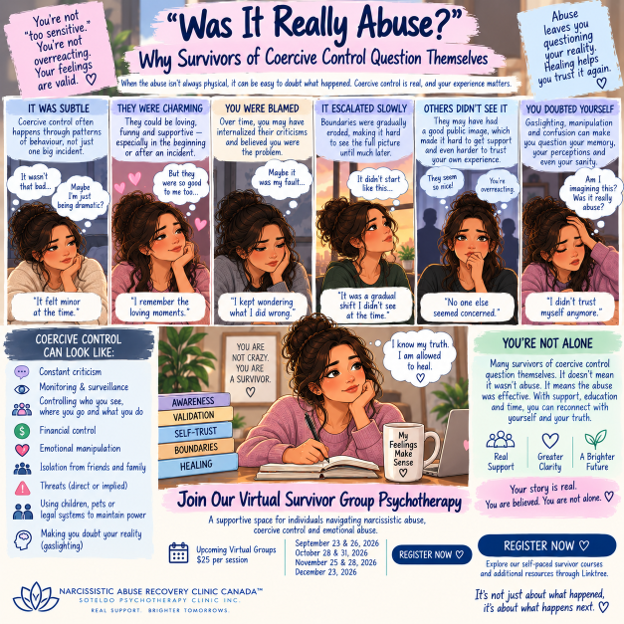
Not every abusive relationship contains one dramatic event that explains everything.
Sometimes it is hundreds of smaller experiences.
A look.
A threat disguised as a joke.
Monitoring.
Isolation.
Criticism.
Financial restriction.
Rules that only apply to you.
Punishment when you disagree.
Being told that something you clearly remember never happened.
Eventually, you may find yourself asking:
“Was it really abuse?”
Incidents Don’t Always Reveal the Pattern
One disagreement may look ordinary.
One angry text may look ordinary.
One criticism may look ordinary.
But coercive control is better understood by looking at patterns, context, and impact, rather than examining every incident in isolation.
What happens when you disagree?
Who has freedom?
Who changes their behaviour to prevent the other person’s reaction?
Who controls the rules?
What happens when you say no?
These questions can reveal information that a simple incident-by-incident account may miss.
Gaslighting Can Affect Confidence in Your Own Perceptions
When your experiences are repeatedly denied, minimized, or rewritten, you may gradually begin checking your own reality against someone else’s.
“Maybe I misunderstood.”
“Maybe I’m too sensitive.”
“Maybe I caused it.”
Over time, this can undermine self-trust.
Image Management Can Add Another Layer
Some controlling individuals present very differently outside the relationship.
Other people may experience them as charming, generous, successful, calm, or helpful.
This can intensify a survivor’s confusion.
“If everyone thinks they’re wonderful, maybe I’m the problem.”
Public presentation, however, doesn’t necessarily tell us what happens privately.
You Don’t Need One Perfect Story
Survivors often feel pressure to explain their experience in a way that makes immediate sense to everyone else.
But complicated relationships rarely fit into one neat story.
Understanding may come from stepping back and asking:
What was the overall pattern?
That shift can be important in rebuilding trust in your own experience.
October Virtual Survivor Group
Our Virtual Survivor Group Psychotherapy provides space to explore these experiences without having to reduce your relationship to one incident.
October 28 & 31
$25 per session | Virtual
Register for Virtual Survivor Group Therapy
In-person groups are also available in Ottawa for $35 per session.
For support you can access on your own schedule, explore our self-paced survivor resources through Linktree.
Visit our Linktree for self-paced survivor courses and recorded resources.