
Narcissistic Abuse Recovery Clinic Canada™
Specialized psychotherapy, survivor support, and professional training for individuals navigating intimate partner violence, coercive control, narcissistic abuse, post-separation abuse, and high-conflict relational trauma.
Across Ontario and Canada
Trauma-informed psychotherapy, clinical supervision and professional education.
Focused clinical practice since 2020
Including post-separation abuse & relational trauma
Safety, validation & empowerment
Education focused on IPV, coercive control and trauma-informed response
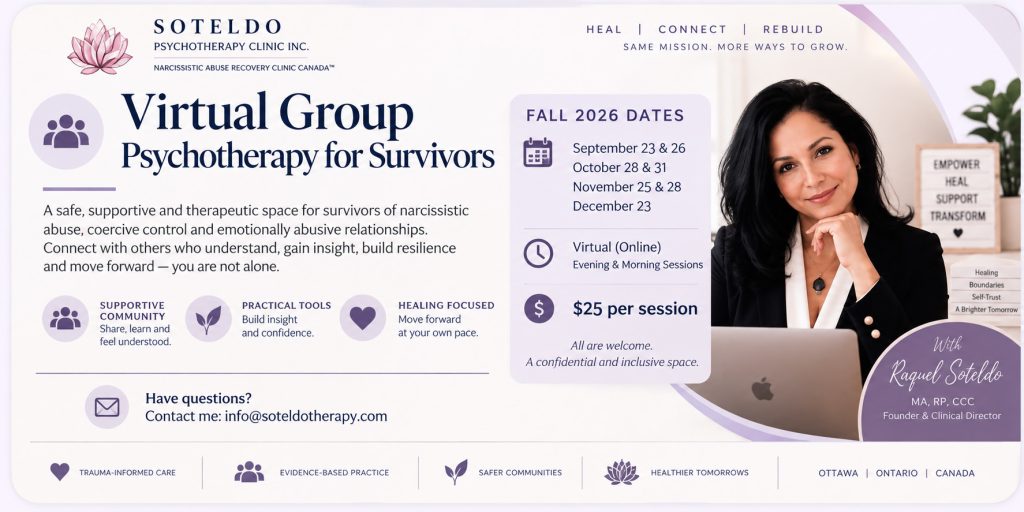
Virtual Group Psychotherapy for Survivors – Fall 2026
Join our virtual group psychotherapy sessions for survivors navigating narcissistic abuse, coercive control, emotional abuse and difficult relationship dynamics. Professionally facilitated sessions provide opportunities for connection, psychoeducation, reflection and recovery in a supportive therapeutic environment. Fall 2026 virtual sessions are available for eligible participants in Ontario.
Can’t attend live? Explore our self-paced courses and recordings. EXPLORE SELF-PACED COURSES →
Have questions? Contact us:
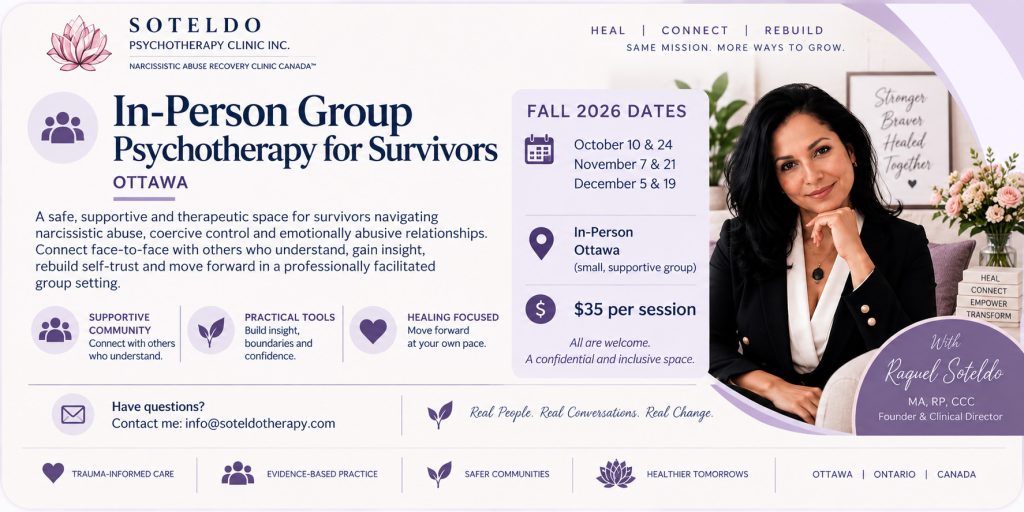
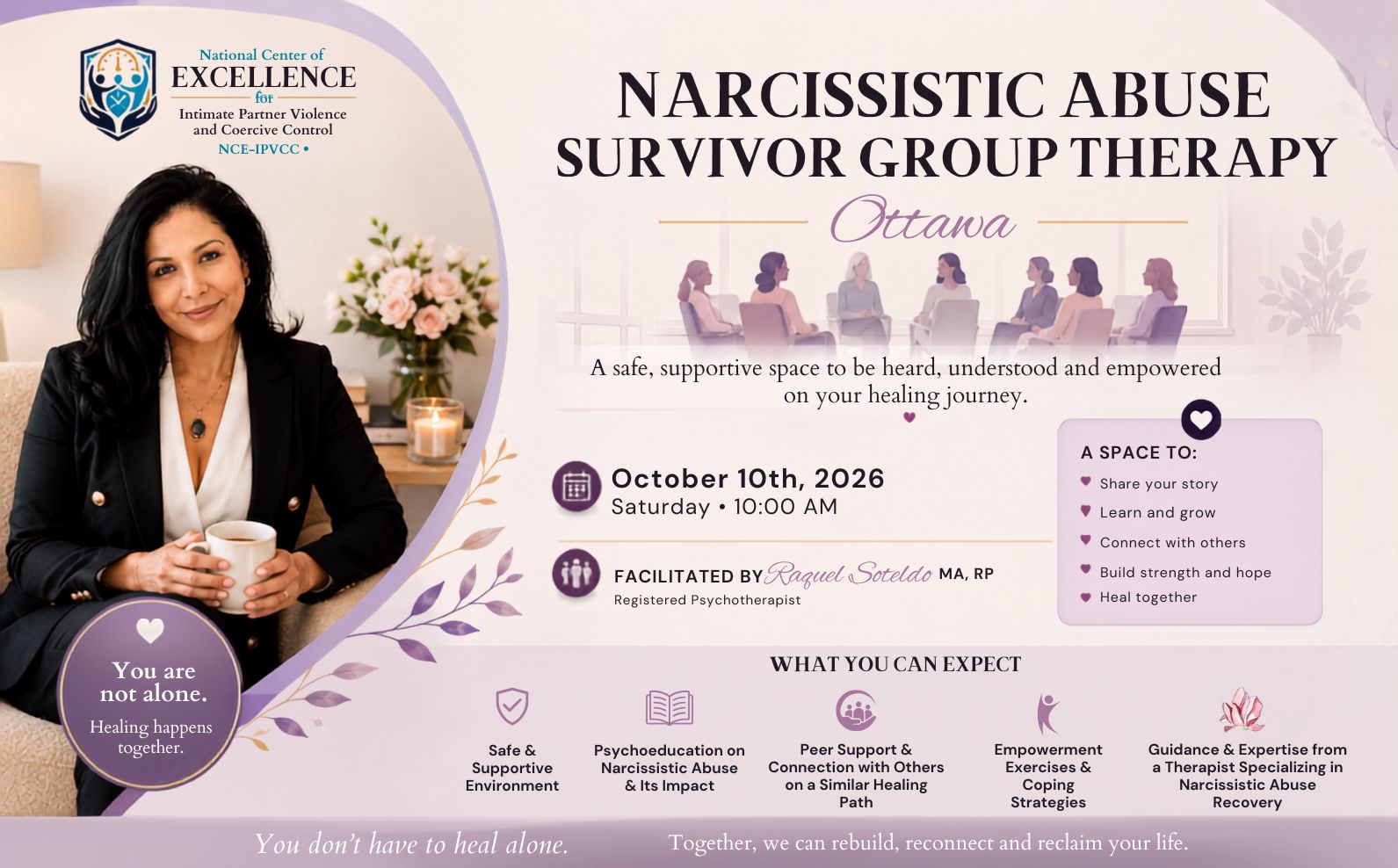
In-Person Group Psychotherapy for Survivors — Ottawa
Join our in-person group psychotherapy sessions in Ottawa for survivors navigating narcissistic abuse, coercive control, emotional abuse and difficult relationship dynamics. Professionally facilitated sessions provide opportunities for therapeutic connection, psychoeducation, reflection and recovery in a supportive group environment.
Can’t attend in person? Explore our virtual groups and self-paced survivor courses.
Have questions? Contact us:
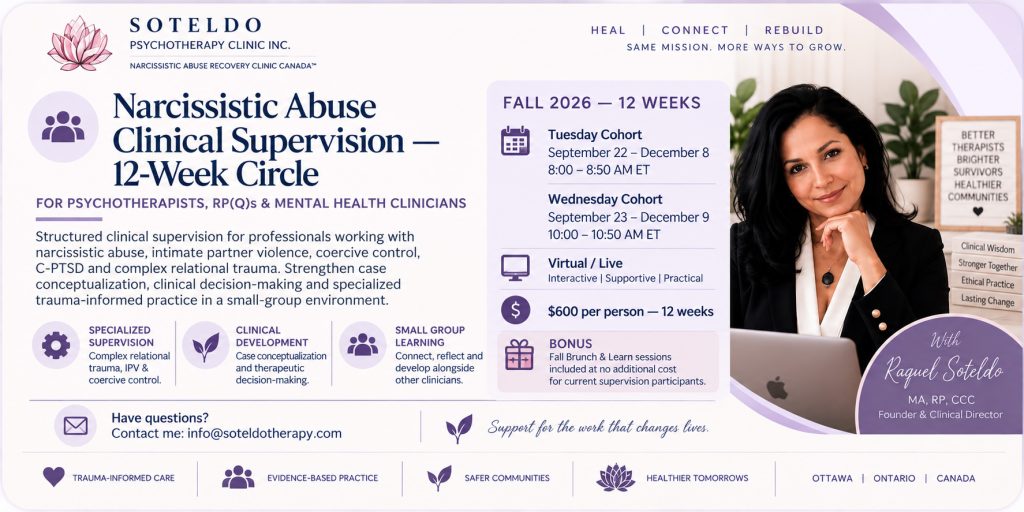
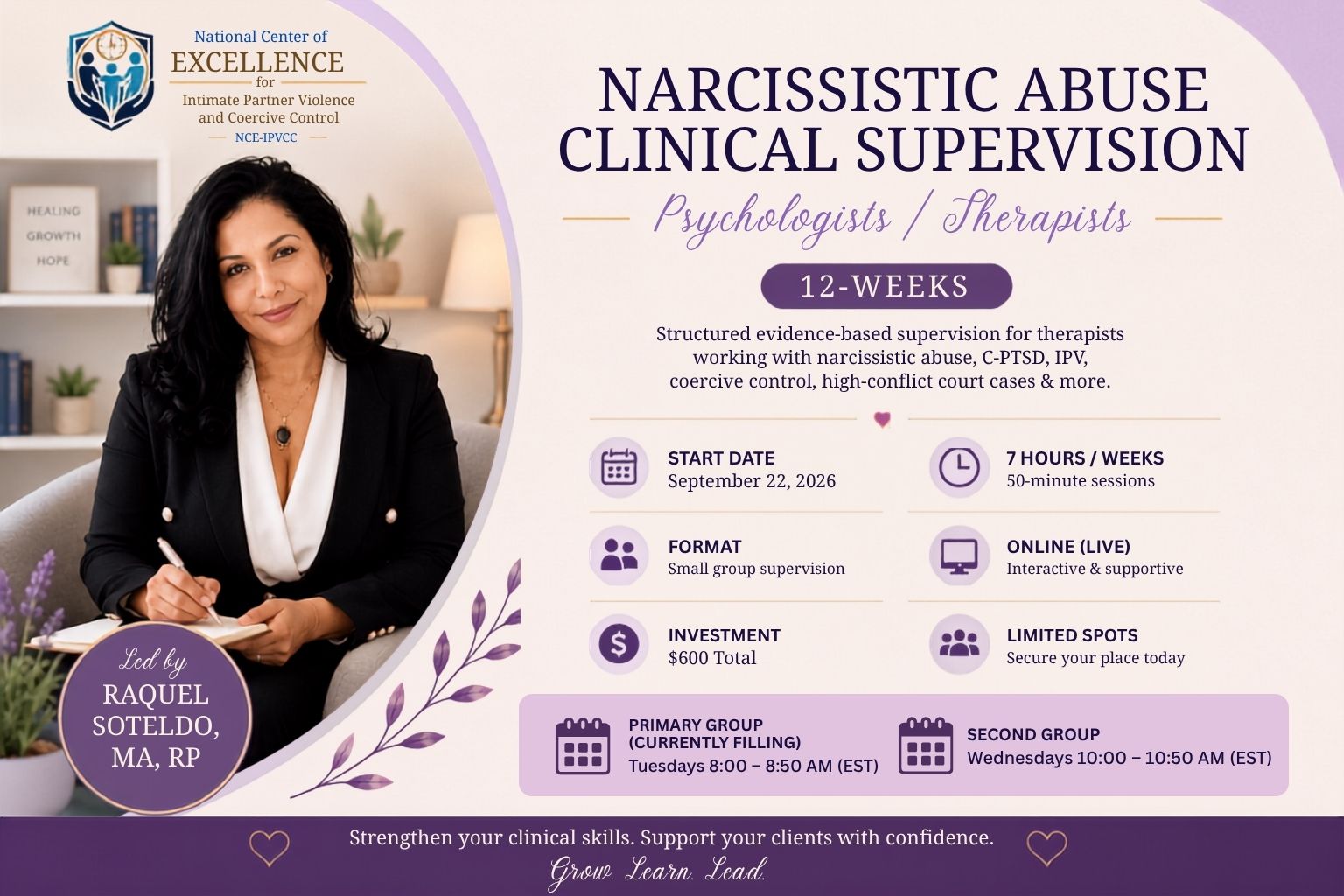
Narcissistic Abuse Clinical Supervision — 12-Week Circle
For psychotherapists, RP(Q)s and mental health clinicians
Current supervision participants receive the Fall Brunch & Learn sessions at no additional cost.
Join Raquel Soteldo, RP for a 12-week virtual clinical supervision circle for psychotherapists, RP(Q)s and qualifying mental health professionals seeking specialized clinical development. Supervision explores complex cases involving narcissistic abuse, intimate partner violence, coercive control, C-PTSD and complex relational trauma, with opportunities to strengthen case conceptualization, therapeutic decision-making and trauma-informed practice.
For psychotherapists, RP(Q)s and mental health clinicians working with complex cases involving narcissistic abuse, IPV, coercive control, C-PTSD and complex relational trauma.
Prefer to learn at your own pace? Explore our self-paced professional courses and recorded trainings. EXPLORE SELF-PACED COURSES →
Have questions? Contact us:
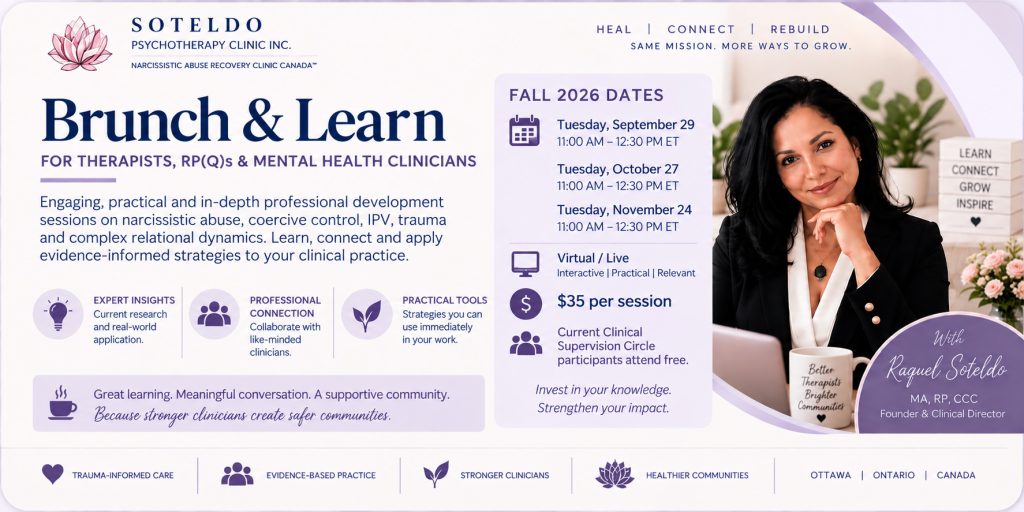
Brunch & Learn for Therapists, RP(Q)s & Mental Health Clinicians
Current Clinical Supervision Circle participants attend FREE.
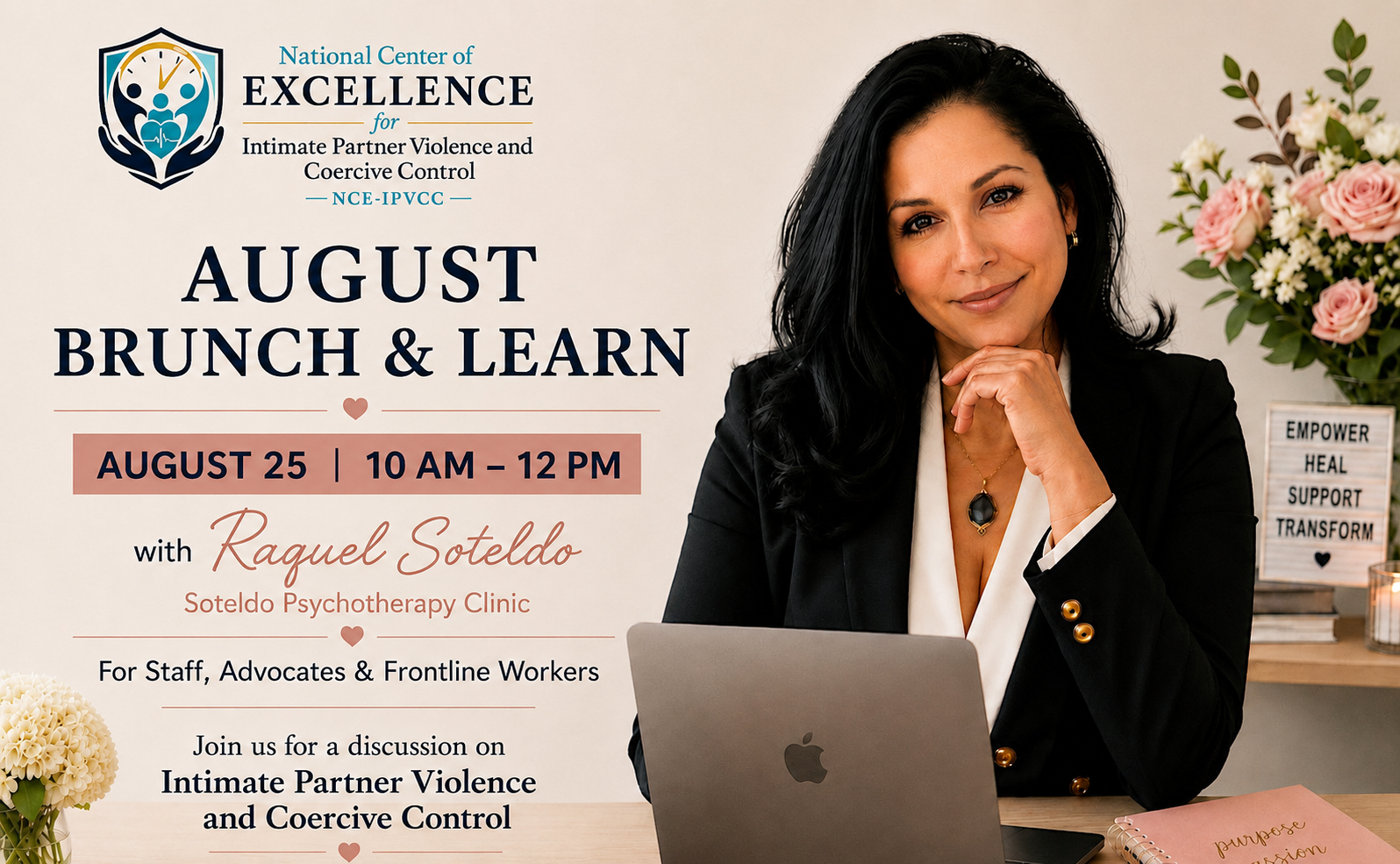
Join Raquel Soteldo, RP for monthly virtual Brunch & Learn professional-development sessions designed for psychotherapists, RP(Q)s and mental health clinicians. Sessions explore specialized clinical topics including narcissistic abuse, intimate partner violence, coercive control, trauma and complex relational dynamics, with practical strategies clinicians can apply to their work.
Interactive professional-development sessions focused on narcissistic abuse, coercive control, IPV, trauma and complex relational dynamics.
Prefer to learn at your own pace? Explore our self-paced professional courses and recorded trainings. EXPLORE SELF-PACED COURSES →
Have questions? Contact us:
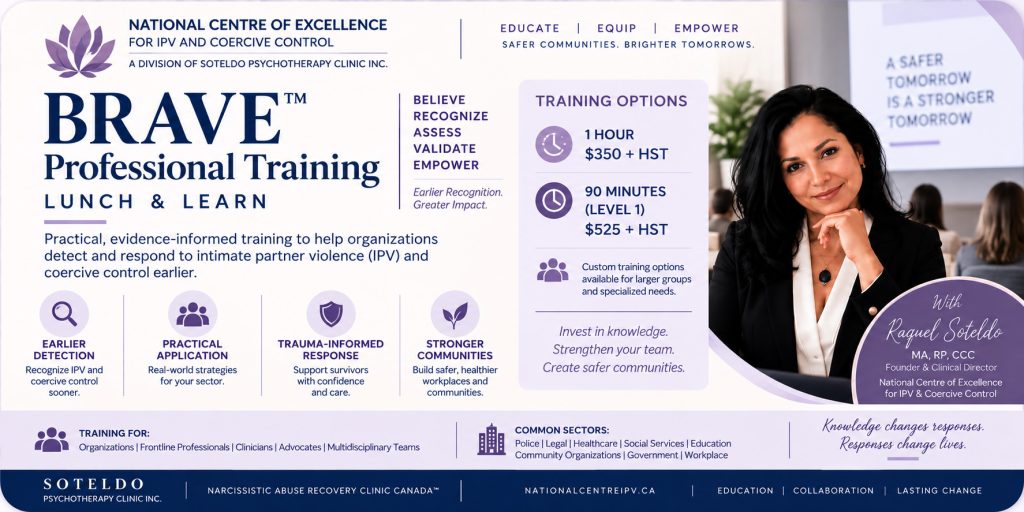
National Centre of Excellence for IPV & Coercive Control
BRAVE™ Professional Training — Lunch & Learn
The National Centre of Excellence for IPV & Coercive Control provides specialized professional training to help organizations and frontline professionals recognize intimate partner violence, coercive control and complex abuse patterns earlier. BRAVE™ Lunch & Learn training provides practical, evidence-informed strategies that professionals can apply within real-world interactions with survivors and families.
Practical, evidence-informed professional training designed to help organizations and frontline professionals detect and respond to intimate partner violence (IPV) and coercive control earlier.
Training can be delivered to larger teams and customized for different sectors and organizational needs.
Relevant Sectors
police/public safety, victim services, legal, healthcare, mental health, social services, education, community organizations, government and workplaces.
Looking for advanced training? Explore our 4-Hour BRAVE™ Workshop.
Have questions? Contact us:
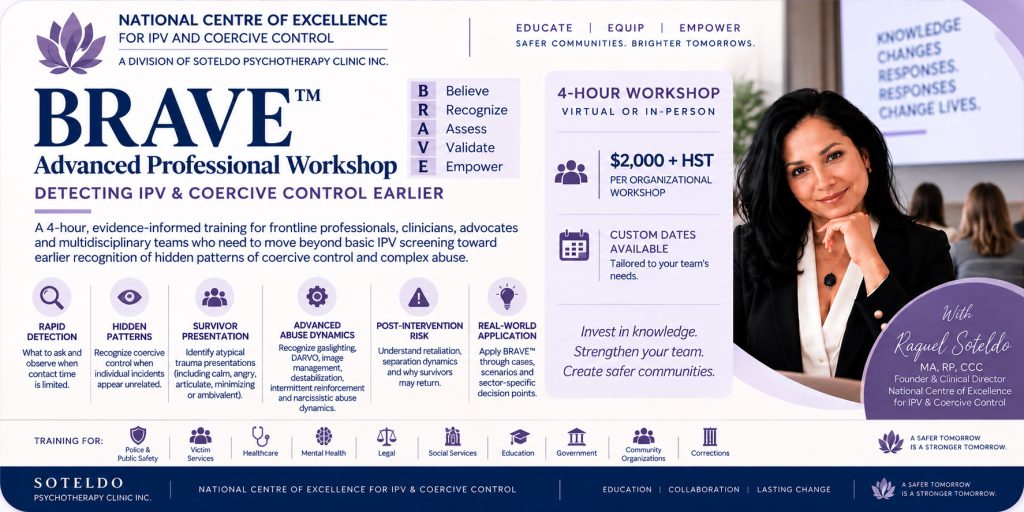
National Centre of Excellence for IPV & Coercive Control
BRAVE™ Advanced Professional Workshop Detecting IPV & Coercive Control Earlier
The National Centre of Excellence for IPV & Coercive Control provides advanced professional training for organizations and frontline professionals seeking to recognize intimate partner violence and coercive control earlier. The 4-Hour BRAVE™ Advanced Professional Workshop moves beyond basic IPV screening to examine hidden patterns of coercive control, atypical survivor presentations, complex abuse dynamics, post-intervention risk and practical sector-specific detection and response.
This is an advanced, evidence-informed training for frontline professionals, clinicians, advocates and multidisciplinary teams who need to move beyond basic IPV screening toward earlier recognition of coercive control and complex abuse patterns.
Workshop Includes
police/public safety, victim services, healthcare, mental health, legal professionals, social services, corrections, education, government, community organizations.
BRAVE™
Believe · Recognize · Assess · Validate · Empower
Appropriate For
police/public safety, victim services, healthcare, mental health, legal professionals, social services, corrections, education, government, community organizations.
Looking for an introductory training option? EXPLORE BRAVE™ LUNCH & LEARN →
Have questions? Contact us:
Designed for clinicians, frontline workers, advocates, and helping professionals supporting clients affected by IPV and coercive control. Learn to recognize hidden abuse patterns, understand survivor responses, assess safety, and respond with practical, trauma-informed strategies that promote greater clarity, confidence, and care.
Structured, evidence-based clinical supervision for professionals working with narcissistic abuse, C-PTSD, IPV, coercive control, and complex relational trauma.
A safe and supportive group therapy space for survivors of narcissistic abuse to share, heal, build connection, and reclaim their confidence with guidance from a registered psychotherapist specializing in narcissistic abuse recovery.
Narcissistic abuse is often part of a broader pattern of intimate partner violence (IPV) and coercive control. While many people associate abuse with physical violence, it frequently occurs through psychological, emotional, financial, and relational tactics that are far less visible but equally harmful. Survivors may experience gaslighting, emotional manipulation, isolation, intimidation, financial control, trauma bonding, post-separation abuse, and ongoing patterns of fear and dependency. Over time, these experiences can erode a person’s confidence, sense of identity, decision-making, and autonomy, leaving them feeling trapped, confused, and disconnected from their own reality. Healing from this kind of trauma requires more than simply understanding what happened—it involves restoring a sense of safety, rebuilding trust in oneself, strengthening healthy boundaries, and addressing the long-term emotional and neurological impact of living under coercive control.
For those who are trying to make sense of their experience, the Survivor’s Journey can help identify the stage of abuse or recovery a person may currently be in, offering language, clarity, and direction for what they may be experiencing. Our trauma-informed approach supports survivors in understanding these patterns, strengthening boundaries, reconnecting with their inner voice, and moving toward greater clarity, confidence, and emotional freedom. This work is part of our broader psychotherapy services for adults.
This work is part of our broader psychotherapy for adults services.
Connect with a therapist to discuss your situation and recovery goals.
Download practical guides and educational resources.
Self-paced programs designed for healing and recovery
Connect with a therapist to discuss your situation and recovery goals.
Download practical guides and educational resources.
Self-paced programs designed for healing and recovery

For many survivors of coercive control and intimate partner violence, being told they are “too sensitive,” “dramatic,” or “imagining things” becomes part of the abuse cycle that makes them doubt their own reality.
Many survivors arrive here feeling confused, overwhelmed, and unsure whether what they experienced even “counts” as abuse. That uncertainty is not a sign of weakness. It is one of the most painful and common effects of narcissistic abuse. When someone has spent months or years minimizing your feelings, twisting the truth, blaming you, or making you question your own reality, it makes sense that trusting yourself again may feel difficult.
But you are not broken. You are not alone. And healing is possible.
This space was created to support you wherever you are in your journey. Here, you’ll find the resources, education, tools, and guidance you need to begin making sense of what happened, understand the stage of abuse or recovery you may be in, rebuild trust in yourself, and take the next step toward clarity, safety, confidence, and emotional freedom.
You do not need to have all the answers before you reach out. You do not need to be completely certain. You do not need to have left the relationship yet. You only need to start where you are.
Being here is already a powerful first step — and you do not have to take the next one alone.
Narcissistic abuse, intimate partner violence, and coercive control often happen quietly and gradually. Survivors may experience gaslighting, trauma bonding, isolation, emotional manipulation, financial control, intimidation, identity erosion, and post-separation abuse.
It didn’t look like control. It looked like concern, rules, criticism, and never quite having enough freedom — or money, or privacy — to feel truly independent.
You remember exactly what happened. They tell you it didn’t. After enough time, you start to believe them.
The good moments feel so real that you stay through the painful ones. That’s not weakness — that’s a trauma response.
It happened slowly. One relationship at a time, until you looked around and realised you were alone.
You stopped sharing how you felt because it was always used against you. So you learned to go quiet instead.
Somewhere along the way, your opinions, preferences, and sense of self stopped feeling like yours. You can’t remember who you were before.
You thought leaving would bring peace. Instead, the control continued through intimidation, legal battles, constant contact, or attempts to keep you afraid.
Take 2 minutes to find out if what you experienced fits the pattern.
Healing does not look the same for everyone. Some people are just beginning to understand what happened. Others are ready for therapy, group support, education, training, or deeper personal change. Wherever you are, these pathways are here to help you move forward with clarity, compassion, and support.
For survivors of intimate partner violence, coercive control, narcissistic abuse, post-separation abuse, and high-conflict relational trauma.
A supportive group space for survivors healing from coercive control, narcissistic abuse, trauma bonding, and emotional abuse.
Training for therapists, frontline workers, legal professionals, community organizations, and agencies responding to IPV, coercive control, narcissistic abuse, and high-conflict family dynamics.
A structured accountability and education program addressing coercive control, intimate partner violence, emotional abuse, high-conflict behaviour, and relational harm.
Healing from narcissistic abuse, intimate partner violence, and coercive control is not linear. Survivors often move through stages of assessment, stabilization, rebuilding, and post-traumatic growth as they recover from emotional abuse, trauma bonding, fear, identity erosion, and post-separation stress.
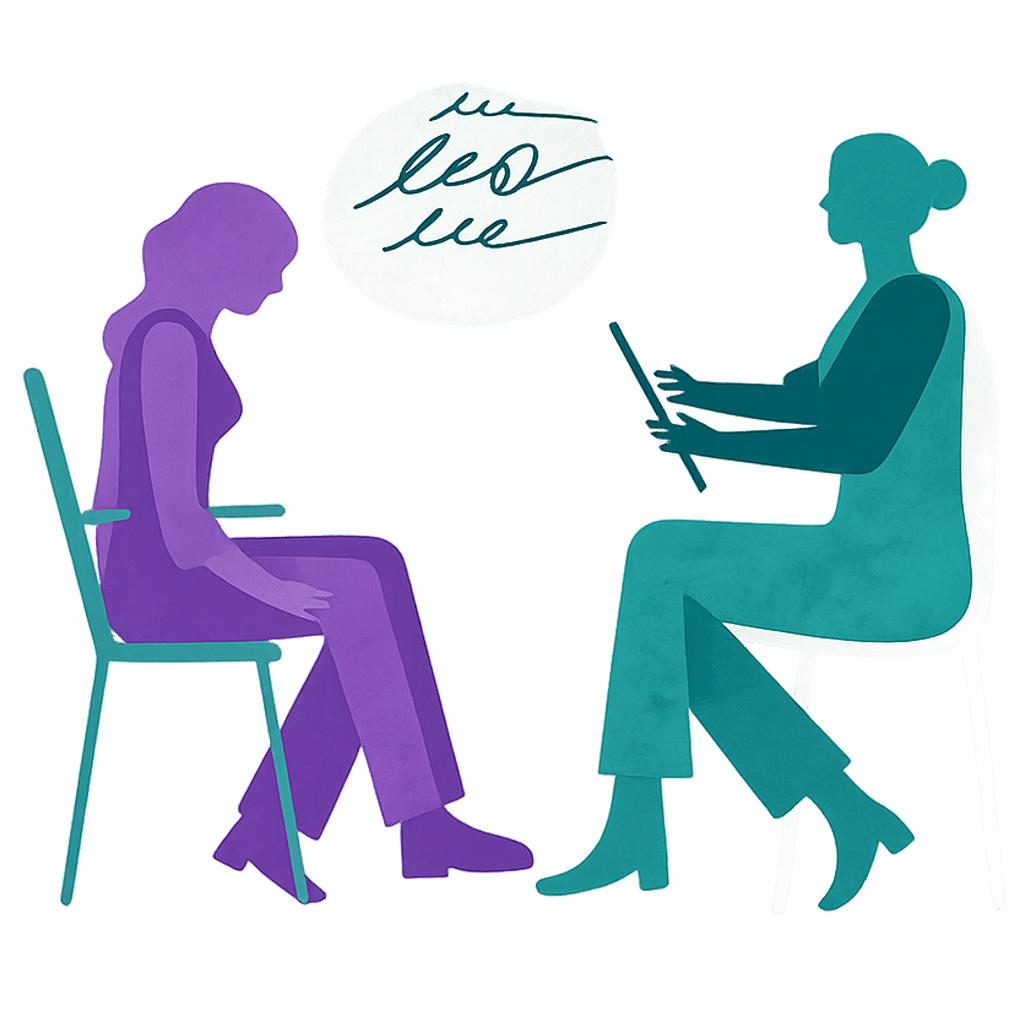
We begin by understanding your experience within the context of narcissistic abuse and relational trauma. This includes identifying patterns such as trauma bonding, emotional dysregulation, and the impact of prolonged psychological stress — without pressure or judgment.
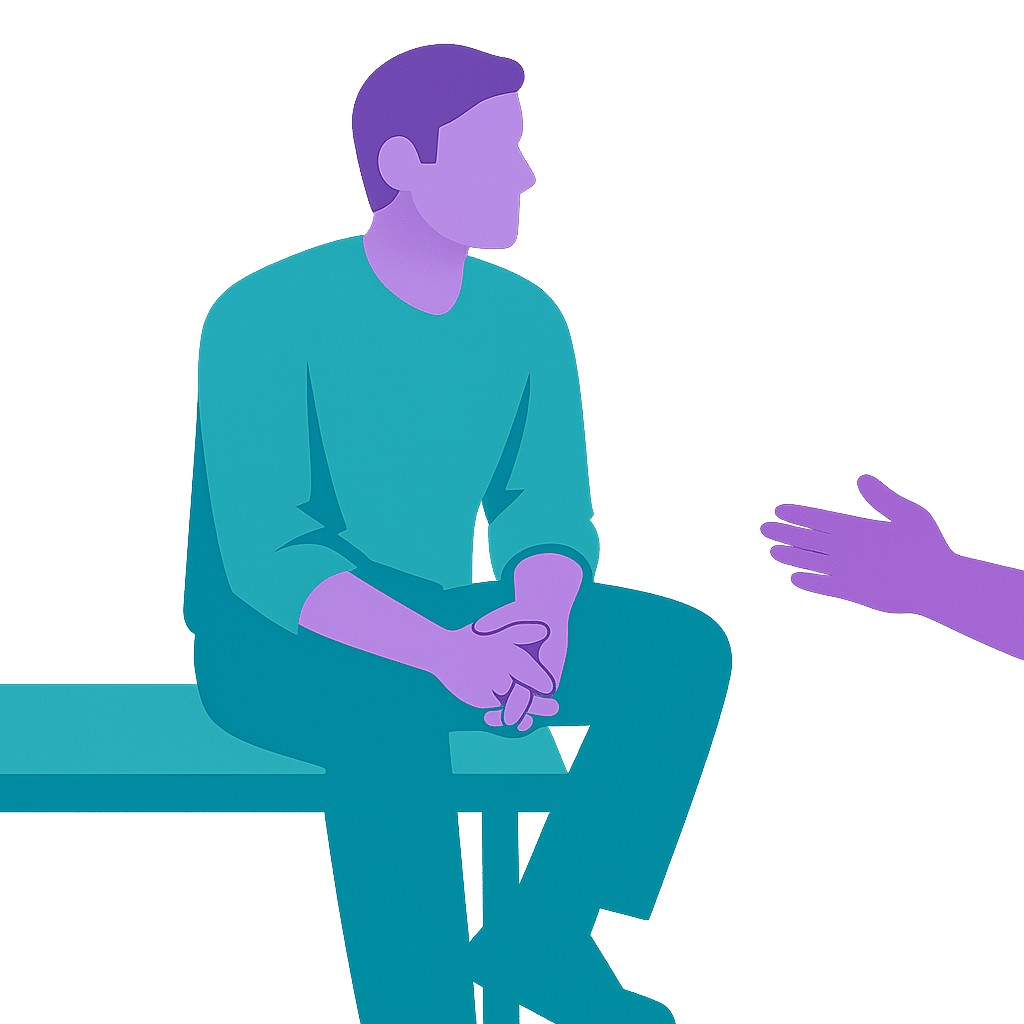
Before processing deeper trauma, we focus on nervous system regulation, emotional safety, and grounding. This phase is essential for individuals recovering from narcissistic abuse, where chronic stress and anxiety often impact daily functioning. This is not a pause — this is foundational work.
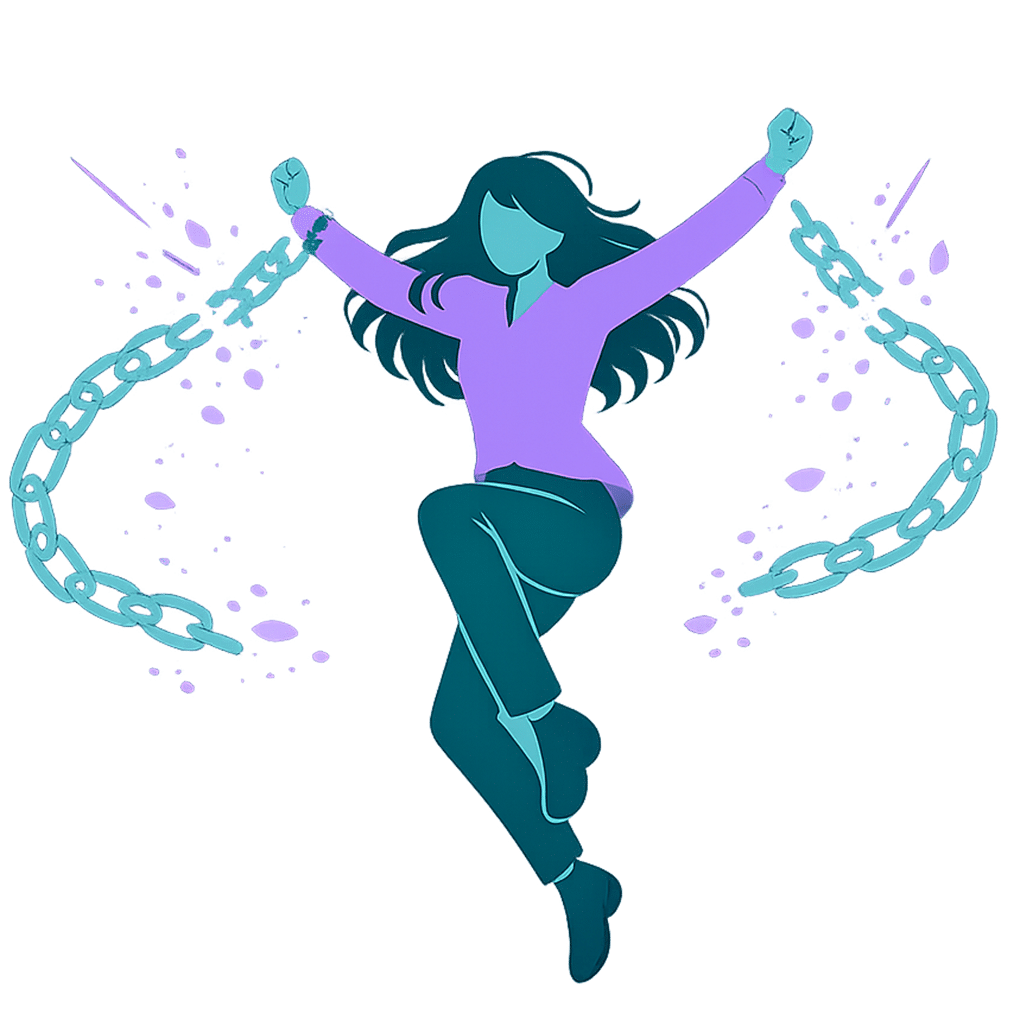
This phase focuses on rebuilding identity, boundaries, and self-trust after narcissistic abuse. We explore who you are outside of the relationship, strengthen decision-making, and develop healthier relational patterns moving forward.

Post-traumatic growth is real. After the deepest wounds have been worked through and healed, many survivors discover strength, wisdom, purpose, and self-trust they never knew were possible. This growth can feel miraculous — your superpower after surviving so much. Take hold of this opportunity to heal, and do not let go of the life waiting for you on the other side.
10 Signs You Are in a Narcissistic Relationship — a free guide by Raquel Soteldo, RP. Enter your email and get instant access.
Your recovery requires more than insight — it requires a trauma-informed therapeutic approach that addresses nervous system regulation, attachment wounds, and the long-term psychological impact of relational abuse.
Clinical Director, Soteldo Psychotherapy Clinic Inc.
Founder, National Center of Excellence for IPV & Coercive Control
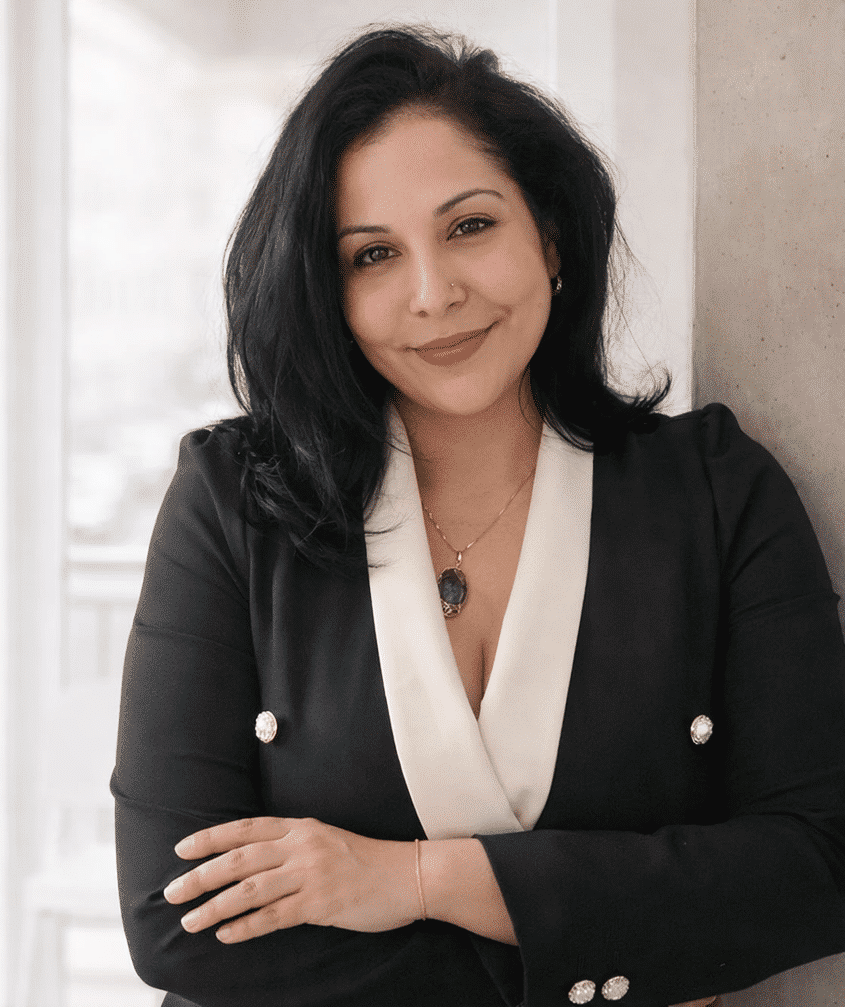
Raquel Soteldo is a Registered Psychotherapist, Canadian Certified Counsellor, Clinical Supervisor, Family Mediator, organizational trainer, and Clinical Director of Soteldo Psychotherapy Clinic Inc. She is also the founder of the National Center of Excellence for IPV & Coercive Control, a national initiative focused on strengthening how professionals and systems recognize, understand, and respond to interpersonal violence and coercive control.
Her clinical practice specializes in intimate partner violence (IPV), coercive control, narcissistic abuse, sociopathic and psychopathic abuse patterns, trauma bonding, psychological and emotional abuse, domestic violence, reproductive coercion, betrayal trauma, and post-separation abuse.
Raquel brings a background in behavioural analysis to her psychotherapy practice. This allows her to examine not only what clients think and feel, but also behavioural patterns, reinforcement cycles, environmental contingencies, relational dynamics, and survival adaptations that can develop within abusive relationships. This lens is particularly relevant to understanding intermittent reinforcement, trauma bonding, coercive behavioural patterns, avoidance, boundary erosion, gaslighting, and the ways survivors may alter their behaviour in response to prolonged control, manipulation, intimidation, or threat.
Her integrative, trauma-informed clinical approach draws from Acceptance and Commitment Therapy (ACT), Cognitive Processing Therapy (CPT)-informed strategies, EMDR-focused trauma treatment strategies, clinical hypnotherapy, behavioural principles, somatic and nervous-system-informed interventions, and psychoeducation. Treatment is individualized and flexible rather than rigidly protocol-driven, allowing interventions to be modified in the moment according to safety, nervous-system activation, dissociation, ongoing contact with an abusive partner or former partner, readiness for trauma processing, and each client’s individual needs and goals.
Raquel is also the creator of the BRAVE Framework — Building Recognition, Advocacy, Validation & Early Response, a trauma- and violence-informed framework designed to strengthen the recognition of IPV and coercive control while promoting validation, survivor agency, safer intervention, advocacy, and earlier response.
Beyond individual psychotherapy, Raquel facilitates therapeutic groups for survivors and provides specialized education and consultation to the professionals and organizations supporting them. She develops and delivers organizational training, professional workshops, and frontline education for staff, service providers, advocates, clinicians, and other professionals who encounter victims and survivors in their work.
She also delivers monthly Lunch & Learn educational sessions and is available for clinical consultation related to IPV and coercive control, including complex presentations involving narcissistic abuse, trauma bonding, post-separation dynamics, psychological abuse, and coercive patterns that may be difficult to identify through incident-based approaches alone.
Through the National Center of Excellence for IPV & Coercive Control, Raquel’s current focus is expanding education, training, consultation, and professional capacity at a national and federal level. The broader goal is to train, teach, and support the individuals and systems responsible for supporting victims and survivors of narcissistic abuse, sociopathic and psychopathic abuse patterns, coercive control, domestic violence, reproductive coercion, and intimate partner violence.
Her work recognizes that survivors frequently interact with multiple systems—including psychotherapy and mental health services, healthcare, victim services, policing, legal and family-court systems, social services, workplaces, and community organizations. Strengthening the knowledge and confidence of the professionals within these systems is therefore an important part of improving survivor response.
Raquel also provides clinical supervision to developing clinicians and university students across Ontario, supporting the development of trauma-informed, ethically grounded, and clinically sophisticated practice.
Alongside her clinical, supervisory, and organizational work, Raquel is currently completing her Doctorate in Counselling Psychology at Yorkville University, further developing her research and advanced clinical work in areas related to interpersonal violence and reproductive coercion.
At the centre of Raquel’s work is the belief that behaviours frequently described as “maladaptive” may have originally developed as intelligent responses to unsafe environments. Her approach therefore begins with curiosity rather than judgment: What function did this response serve? What was the person adapting to? Is that response still protecting them today? And what new choices become possible when safety, autonomy, psychological flexibility, and self-trust are restored?
Across psychotherapy, survivor groups, clinical supervision, consultation, professional education, and systems-level training, Raquel’s work has a common objective: to improve how we recognize abuse, how we respond to survivors, and how we equip the people responsible for supporting them.
Raquel brings a background in behavioural analysis to her psychotherapy practice. This allows her to examine not only what clients think and feel, but also behavioural patterns, reinforcement cycles, environmental contingencies, relational dynamics, and survival adaptations that can develop within abusive relationships. This lens is particularly relevant to understanding intermittent reinforcement, trauma bonding, coercive behavioural patterns, avoidance, boundary erosion, gaslighting, and the ways survivors may alter their behaviour in response to prolonged control, manipulation, intimidation, or threat.
Her integrative, trauma-informed clinical approach draws from Acceptance and Commitment Therapy (ACT), Cognitive Processing Therapy (CPT)-informed strategies, EMDR-focused trauma treatment strategies, clinical hypnotherapy, behavioural principles, somatic and nervous-system-informed interventions, and psychoeducation. Treatment is individualized and flexible rather than rigidly protocol-driven, allowing interventions to be modified in the moment according to safety, nervous-system activation, dissociation, ongoing contact with an abusive partner or former partner, readiness for trauma processing, and each client’s individual needs and goals.
Raquel is also the creator of the BRAVE Framework — Building Recognition, Advocacy, Validation & Early Response, a trauma- and violence-informed framework designed to strengthen the recognition of IPV and coercive control while promoting validation, survivor agency, safer intervention, advocacy, and earlier response.
Beyond individual psychotherapy, Raquel facilitates therapeutic groups for survivors and provides specialized education and consultation to the professionals and organizations supporting them. She develops and delivers organizational training, professional workshops, and frontline education for staff, service providers, advocates, clinicians, and other professionals who encounter victims and survivors in their work.
She also delivers monthly Lunch & Learn educational sessions and is available for clinical consultation related to IPV and coercive control, including complex presentations involving narcissistic abuse, trauma bonding, post-separation dynamics, psychological abuse, and coercive patterns that may be difficult to identify through incident-based approaches alone.
Through the National Center of Excellence for IPV & Coercive Control, Raquel’s current focus is expanding education, training, consultation, and professional capacity at a national and federal level. The broader goal is to train, teach, and support the individuals and systems responsible for supporting victims and survivors of narcissistic abuse, sociopathic and psychopathic abuse patterns, coercive control, domestic violence, reproductive coercion, and intimate partner violence.
Her work recognizes that survivors frequently interact with multiple systems—including psychotherapy and mental health services, healthcare, victim services, policing, legal and family-court systems, social services, workplaces, and community organizations. Strengthening the knowledge and confidence of the professionals within these systems is therefore an important part of improving survivor response.
Raquel also provides clinical supervision to developing clinicians and university students across Ontario, supporting the development of trauma-informed, ethically grounded, and clinically sophisticated practice.
Alongside her clinical, supervisory, and organizational work, Raquel is currently completing her Doctorate in Counselling Psychology at Yorkville University, further developing her research and advanced clinical work in areas related to interpersonal violence and reproductive coercion.
At the centre of Raquel’s work is the belief that behaviours frequently described as “maladaptive” may have originally developed as intelligent responses to unsafe environments. Her approach therefore begins with curiosity rather than judgment: What function did this response serve? What was the person adapting to? Is that response still protecting them today? And what new choices become possible when safety, autonomy, psychological flexibility, and self-trust are restored?
Across psychotherapy, survivor groups, clinical supervision, consultation, professional education, and systems-level training, Raquel’s work has a common objective: to improve how we recognize abuse, how we respond to survivors, and how we equip the people responsible for supporting them.
Self-paced survivor education for individuals recovering from narcissistic abuse, intimate partner violence, coercive control, trauma bonding, emotional abuse, and post-separation abuse.
Learn how to identify, set, and maintain healthy boundaries after narcissistic abuse.
A practical guide to setting boundaries with difficult people in your life.
This session explores how childhood attachment wounds create emotional caretaking roles, increasing vulnerability to narcissistic abuse.
Clinical insights into identifying and addressing less visible forms of violence, including psychological and coercive control.
Professional training for therapists, social workers, frontline workers, and helping professionals supporting survivors of intimate partner violence, coercive control, narcissistic abuse, trauma bonding, and post-separation abuse.
Narcissistic abuse is one of the most misunderstood presentations in clinical practice. This course gives therapists a structured, trauma-informed framework to accurately conceptualise cases, plan treatment effectively and support meaningful client progress — with a specific focus on identity erosion as a core clinical marker.
The business side of private practice — client acquisition, ethical marketing, systems and CRPO-aligned standards — can feel overwhelming and unclear. This course provides practical, real-world guidance to help you build a sustainable and compliant practice from the start with confidence.
Structured therapeutic programs designed for individuals healing from narcissistic abuse and high-conflict relationships.
Structured therapeutic programs designed for individuals healing from narcissistic abuse and high-conflict relationships.
One-on-one trauma-informed therapy for survivors healing from narcissistic abuse.
Heal alongside others who understand in a safe, therapist-led group setting.
Structured support for survivors navigating high-conflict and coercive relationships.
Soteldo Psychotherapy Clinic is developing the National Center of Excellence for IPV and Coercive Control, a training, consultation, and education initiative designed to support survivors, clinicians, frontline professionals, legal systems, and community organizations across Ontario and Canada.
This initiative focuses on improving understanding, detection, documentation, treatment planning, referral pathways, and trauma-informed responses to intimate partner violence, coercive control, narcissistic abuse, and post-separation abuse.
Advanced clinical support and training for therapists working with narcissistic abuse, trauma, and complex relational cases.
Advanced clinical support and training for therapists working with narcissistic abuse, trauma, and complex relational cases.
Clinical supervision for therapists working with narcissistic abuse and complex trauma.
Practical treatment planning sessions for therapists in a relaxed learning format.
Clinical supervision and professional training for therapists working with IPV, coercive control, narcissistic abuse recovery, trauma bonding, post-separation abuse, and high-conflict relationships.
Clinical supervision for therapists.
Structured programs addressing coercive control, intimate partner violence, emotional abuse, accountability, relational harm, and high-conflict behaviour.
Workshops and training for agencies, workplaces, frontline teams, legal professionals, and community organizations responding to IPV, coercive control, narcissistic abuse, and family violence.
Our Structured Intimate Partner Violence (IPV) Group Program is a 12-session, accountability-based intervention designed for individuals involved in domestic violence or IPV-related matters who are seeking meaningful behavioural change and structured support.
The program focuses on emotional regulation, power and control dynamics, cognitive distortions, conflict de-escalation, and the development of healthier relationship patterns within a clinically guided group setting.
Including those awaiting or participating in Partner Assault Response (PAR), or those requiring structured counselling as part of legal, probation, or personal growth goals.
Targeted programs designed for individuals navigating specific challenges related to emotional regulation and relational conflict.
Targeted programs designed for individuals navigating specific challenges related to emotional regulation and relational conflict.
Evidence-based tools for understanding and regulating anger rooted in relational trauma.
Trauma-informed parenting support for survivors raising children after narcissistic abuse.
Our Structured Intimate Partner Violence (IPV) Group Program is a 12-session, accountability-based intervention designed for individuals involved in domestic violence or IPV-related matters who are seeking meaningful behavioural change and structured support.
Training and workshops for professionals working in high-conflict and trauma-informed environments.
Training and workshops for professionals working in high-conflict and trauma-informed environments.
Workplace training on emotional intelligence, trauma, and high-conflict communication.
Specialised training for frontline professionals working in trauma and conflict settings.

A therapist-led group designed for individuals leaving or recovering from abusive relationships, with a focus on understanding the differences between narcissistic, sociopathic, and psychopathic abuse.
Different survivors need different forms of support, depending on where they are in their healing.
For parents healing while protecting their children
For navigating separation and ongoing conflict
Ready to take the next step? Book your free 15-min consultation with Raquel today.
Yes. The clinic provides trauma-informed psychotherapy, group therapy, survivor education, and consultation for individuals impacted by intimate partner violence, coercive control, narcissistic abuse, emotional abuse, and post-separation abuse.
No. Coercive control can include intimidation, isolation, monitoring, financial control, threats, gaslighting, emotional manipulation, and behaviours that limit a person’s freedom, autonomy, safety, and sense of self.
Yes. The clinic provides training, consultation, and supervision for therapists, frontline workers, organizations, and professionals responding to IPV, coercive control, narcissistic abuse, and high-conflict relational dynamics.
Yes. Attachment-based therapy helps survivors understand and heal the relational wounds that often keep trauma bonds and self-doubt in place.
Yes. Parent coaching is designed to support survivors while they are healing—helping protect children emotionally and reduce overwhelm without requiring perfection.
Recovery from narcissistic abuse is rarely linear. Many survivors find reassurance in understanding the healing process over time.
You don’t need to be ready — you just need to be curious. Your first session is simply a conversation. There is no pressure to commit to anything.
We talk. Raquel will ask about your experience, what feels most urgent, and what you’re hoping to work toward. There is no evaluation — just a safe conversation at your pace.
Yes. Information shared in psychotherapy is confidential, subject to applicable legal, ethical and professional limits to confidentiality.
Yes. Sessions are available both virtually and in-person across Ontario. Virtual sessions are available province-wide.
Absolutely. Many clients arrive here with exactly that uncertainty. You don’t need a label or a diagnosis to deserve support.
Your first session is simply a conversation. No pressure, no commitment. Information shared in psychotherapy is confidential, subject to applicable legal, ethical and professional limits to confidentiality. We work at your pace, toward a life that feels like yours again.

Just write a few words about what you’re going through — and Raquel will personally write back with exactly what she recommends for you.
No judgment. No pressure. Just someone who has heard it all before.

Select the course you’re interested in and we’ll notify you as soon as it becomes available.
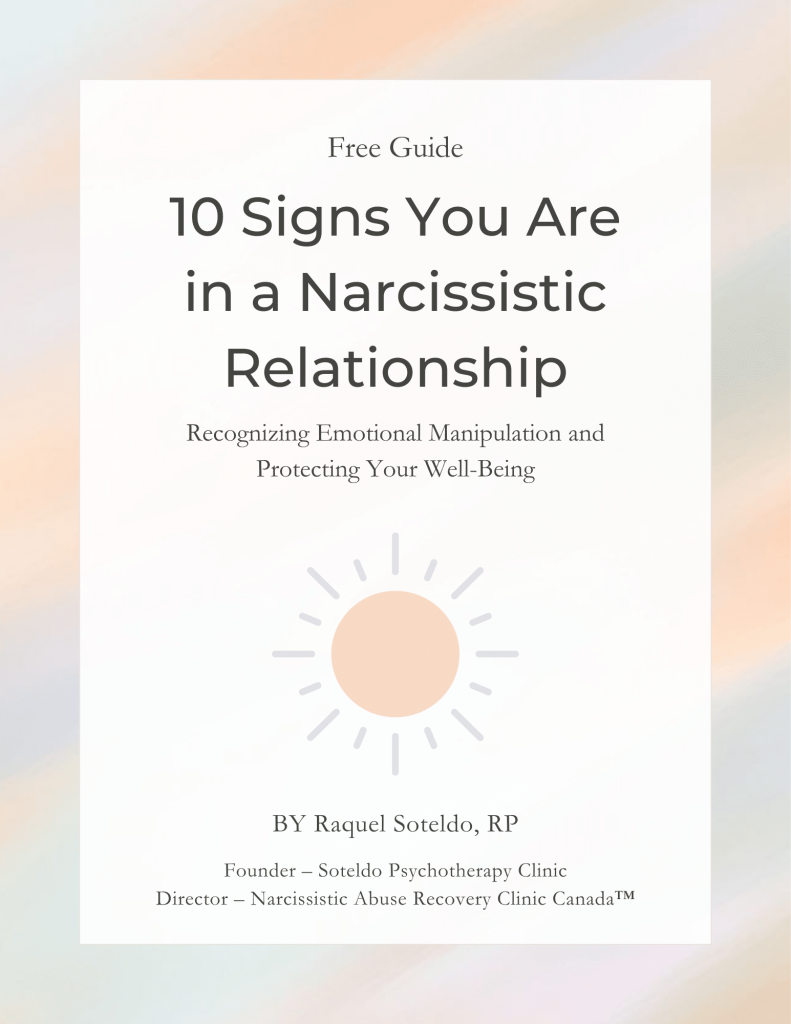
Enter your email below to get instant access to the guide: 10 Signs You Are in a Narcissistic Relationship.