
Professional education — not psychotherapy.
12-Week Virtual Supervision Series
Structured evidence-based supervision working with C-PTSD, Intimate Partner Violence and Coercive Control, High-Conflict Court cases, more.
Jurisdiction and eligibility: Clinical supervision requirements differ by profession, training program and jurisdiction. Participation does not guarantee that supervision hours will be recognized or accepted by a regulatory body, educational institution, employer or certification organization. Before registering, participants are responsible for confirming eligibility and acceptance requirements directly with their own regulator, school, employer or professional association.
Clinical supervision is a professional service focused on clinical work, ethical decision-making, competence and professional development. It is not psychotherapy or personal counselling.
$600
Total
10–12 Hours
Group Meets
Spots

12-Week Virtual Supervision Series
Format
12-week supervision series
Session length
50–60 minutes
Group size
Small group format
Delivery
Investment
$600 total
Start date
Tuesday
Wednesday
Thursday
10:00–11:00 a.m. ET
Jan 7 – Apr 1, 2027 · 12 sessions
Applied learning, with more role simulations
Why This Supervision Is Different
12 weeks. 12 areas of specialty clinical practice. One integrated approach to understanding and treating the complex realities of narcissistic abuse, coercive control and relational trauma.
What You’ll Learn
Trauma-Informed Clinical Practice
This is an interactive clinical supervision group, not simply a lecture series.
Sessions will integrate:
Participants are encouraged to bring de-identified clinical cases and practice questions for supervision and discussion.
Clinical Supervision for Therapists
This group is appropriate for clinicians who already possess foundational competencies in psychotherapy, therapeutic alliance, trauma-informed care, consent, confidentiality, assessment and crisis response and who want to develop greater specialty competence in working with narcissistic abuse, coercive control, IPV and relational trauma.

Participation in this series supports professional development, clinical supervision and specialty learning. It does not constitute an external professional certification or authorize practice beyond a participant’s regulated scope, demonstrated competence or applicable professional standards.
Participants remain responsible for practising within their professional scope, regulatory requirements and level of competence and for obtaining additional consultation, supervision, referral or emergency support when clinically required.
Coercive Control & Relational Trauma
1
Week 1
Seeing the Pattern Without Diagnosing the Partner
2
Week 2
Coercive Control and Power-and-Control Dynamics
3
Week 3
Reality Erosion: Gaslighting, Projection, Blame-Shifting & DARVO
4
Week 4
Trauma Bonding, Intermittent Reinforcement & Cognitive Dissonance
5
Week 5
Survivor Presentation: Trauma Responses, Dissociation, Shame & Identity Erosion
6
Week 6
The Body Under Chronic Relational Threat
7
Week 7
Stabilization & Nervous-System-Informed Somatic Practice
8
Week 8
Safety, Risk & Working With Clients Who Remain in the Relationship
9
Week 9
After Leaving: Grief, Attachment, Boundaries & Rebuilding Agency
10
Week 10
Post-Separation & Systems Abuse
11
Week 11
Integrated Treatment Planning, Documentation & Couples-Therapy Decisions
12
Week 12
Ethical Specialty Practice, Intersectionality, Countertransference & Collaboration
January 2027 Enrollment Invitation
From foundational knowledge to applied clinical competence and advanced study in intimate partner violence, coercive control, and narcissistic abuse.
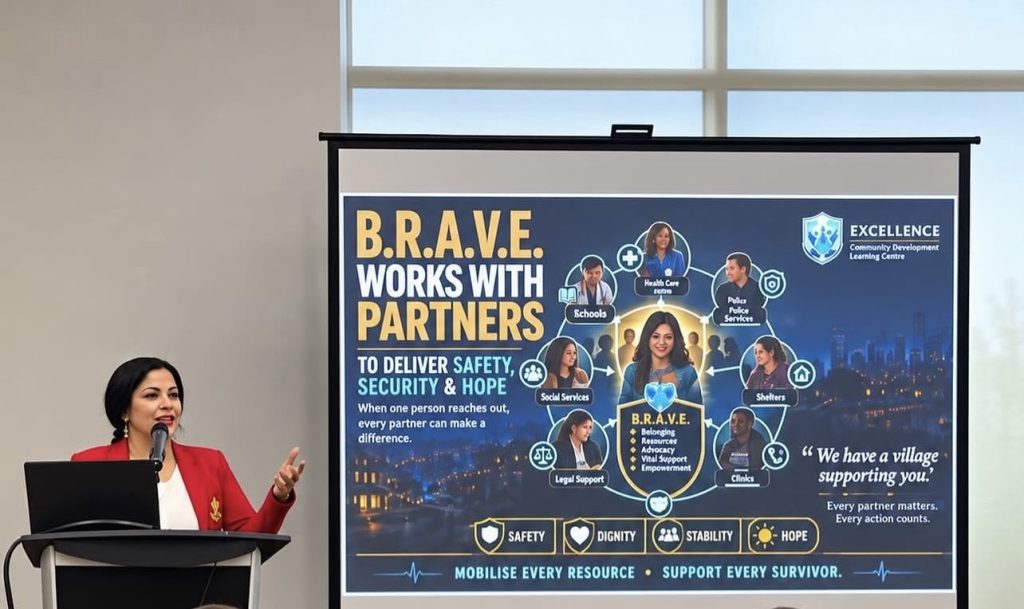
The B.R.A.V.E. Clinical Training Pathway, developed by Raquel Soteldo, RP, is designed for psychotherapists, counsellors, social workers, and other qualified professionals seeking to strengthen their understanding and clinical response to relational trauma. Participants are invited to join one of three progressive levels, based on their previous training, professional experience, and learning goals. Levels 1 and 2 begin January 2027. Level 3 begins September 2027.
Level 01 — Foundational
01
12-Week Clinical Education & Supervision Program
Develop a comprehensive foundational understanding of intimate partner violence, coercive control, narcissistic abuse dynamics, and their psychological impact.
Participants explore trauma responses, coercive patterns, therapeutic engagement, clinical boundaries, safety considerations, and B.R.A.V.E.-informed treatment planning. The program emphasizes survivor-centred, trauma-informed approaches and ethical clinical decision-making.
Ideal for: Professionals beginning to work with survivors or seeking a structured foundation in IPV and coercive control.
January 2027 invitation: Join our next Level 1 cohort and build the clinical foundation necessary to recognize, understand, and respond to complex relational trauma.

Level 02 — Applied Practice
02
12-Week Experiential Role-Playing & Case Consultation Program
Move beyond theoretical knowledge into the practical application of trauma-informed clinical skills through structured role-playing, simulated client encounters, complex case discussions, and guided feedback.
Participants practise responding to disclosures, recognizing coercive control, navigating risk and safety conversations, supporting clients experiencing ongoing abuse, and developing appropriate treatment plans. Exercises also address documentation, clinical boundaries, and post-separation abuse.
Ideal for: Professionals who have completed Level 1 or possess comparable foundational knowledge and want to strengthen their applied clinical skills.
January 2027 group — Thursdays, 10:00–11:00 a.m. ET. Ready to put your knowledge into practice? Join Level 2 and develop greater confidence in navigating challenging clinical encounters through guided simulations and professional feedback.
Level 03 — Advanced Study
03
Advanced Research, Theory & Complex Case Formulation
Engage in an academically rigorous exploration of intimate partner violence, coercive control, narcissistic personality features, complex trauma, and their implications for clinical assessment and intervention.
Participants critically examine empirical research, theoretical frameworks, differential diagnosis, risk assessment approaches, psychological consequences of prolonged coercion, and evidence-informed treatment models. Advanced case formulation, ethical dilemmas, and multidisciplinary considerations are integrated throughout.
Ideal for: Experienced clinicians, supervisors, and professionals seeking advanced theoretical knowledge, research literacy, and complex case-formulation skills.
Begins September 2027. Deepen your professional practice through Level 3, an advanced learning experience designed to strengthen clinical reasoning, critical scholarship, and focused understanding of IPV and coercive control.

Develop your clinical knowledge, skills, and professional judgment through structured, reflective supervision.
Our clinical supervision approach is informed by the College of Registered Psychotherapists of Ontario (CRPO) Entry-to-Practice Competency Profile and Professional Practice Standards.
Through case consultation, clinical formulation, reflective discussion, and individualized feedback, supervisees are supported in developing competencies across five professional domains:
Strengthen theoretical integration, trauma-informed understanding, cultural responsiveness, and awareness of how personal and professional factors influence clinical practice.
Develop professional communication, appropriate boundaries, collaborative consultation, and effective interdisciplinary relationships.
Strengthen ethical decision-making, confidentiality, clinical documentation, professional accountability, reflective practice, and recognition of the limits of professional competence.
Develop clinical reasoning in assessment, risk recognition, therapeutic relationships, case conceptualization, individualized treatment planning, intervention selection, and ongoing evaluation of client progress.
Strengthen the ability to critically evaluate relevant professional literature and integrate research-informed knowledge into clinical decisions.
Our 12-week B.R.A.V.E. supervision curriculum applies these professional competency areas to complex clinical presentations involving intimate partner violence, coercive control, narcissistic relational harm, complex trauma, and post-separation abuse.
Participants engage in guided case discussions, practical clinical exercises, ethical reflection, and treatment-planning activities.
Supervisees are encouraged to identify professional strengths, reflect on areas for growth, and establish individualized learning objectives.
Structured competency self-assessments and supervisory feedback may be used to support professional development and guide future supervision priorities.
Supervisees may participate in structured self-assessment, competency-focused case review, and individualized learning planning informed by CRPO’s published supervision resources.
Our commitment: To support safe, ethical, reflective, and clinically responsible psychotherapy practice while respecting each supervisee’s scope, experience, and professional obligations.
Regulatory clarification: This supervision program is independently offered and informed by CRPO competency expectations. It is not endorsed, accredited, or certified by CRPO. Eligibility of supervision hours toward registration requirements depends on meeting applicable CRPO criteria.
If you are looking for structured, focused supervision for complex cases, this is a strong fit. Register now to join the Tuesday 8:00–9:00 a.m. ET group.
Jurisdiction and eligibility: Clinical supervision requirements differ by profession, training program and jurisdiction. Participation does not guarantee that supervision hours will be recognized or accepted by a regulatory body, educational institution, employer or certification organization. Before registering, participants are responsible for confirming eligibility and acceptance requirements directly with their own regulator, school, employer or professional association.
Questions: info@soteldotherapy.com
Answers
This is clinical supervision for therapists. It is not therapy, coaching, or personal support. Discussion focuses on clinical work, ethical decision-making, and treatment planning.
No. This supervision circle supports both:
Yes. Registered Psychotherapists (Qualifying) and early-career therapists are welcome. Supervision is structured to support skill development, ethical practice, and clinical confidence.
Yes. Participants receive a letter of confirmation of attendance documenting clinical supervision hours. Eligibility of these hours toward registration requirements depends on meeting applicable CRPO criteria.
This is a closed supervision cycle. While occasional absences can be discussed, consistency is important for group safety and depth. Sessions are not recorded.
These cases often require additional consultation. This can be discussed during the screening call to ensure appropriate support.
It says free because once you sign up, you will be sent a link from JANEAPP and that is where the payment is made. It can be divided into 2 different payments: one before it begins and the other at the mid-way point. Either way, once you enroll, you are committing to the 12 weeks.
I work with CBT, ACT, CPT, NLP, clinical hypnosis, Psychoanalysis, and Mindfulness — among others. Come prepared to learn about treatment planning for these clients. Documents are sent to you to learn more about it in between sessions.
Just write a few words about what you’re going through — and Raquel will respond with general information about services that may be relevant to your needs. An inquiry-form response is not a clinical assessment or individualized treatment recommendation.
No judgment. No pressure. Just someone who will hear you now.