
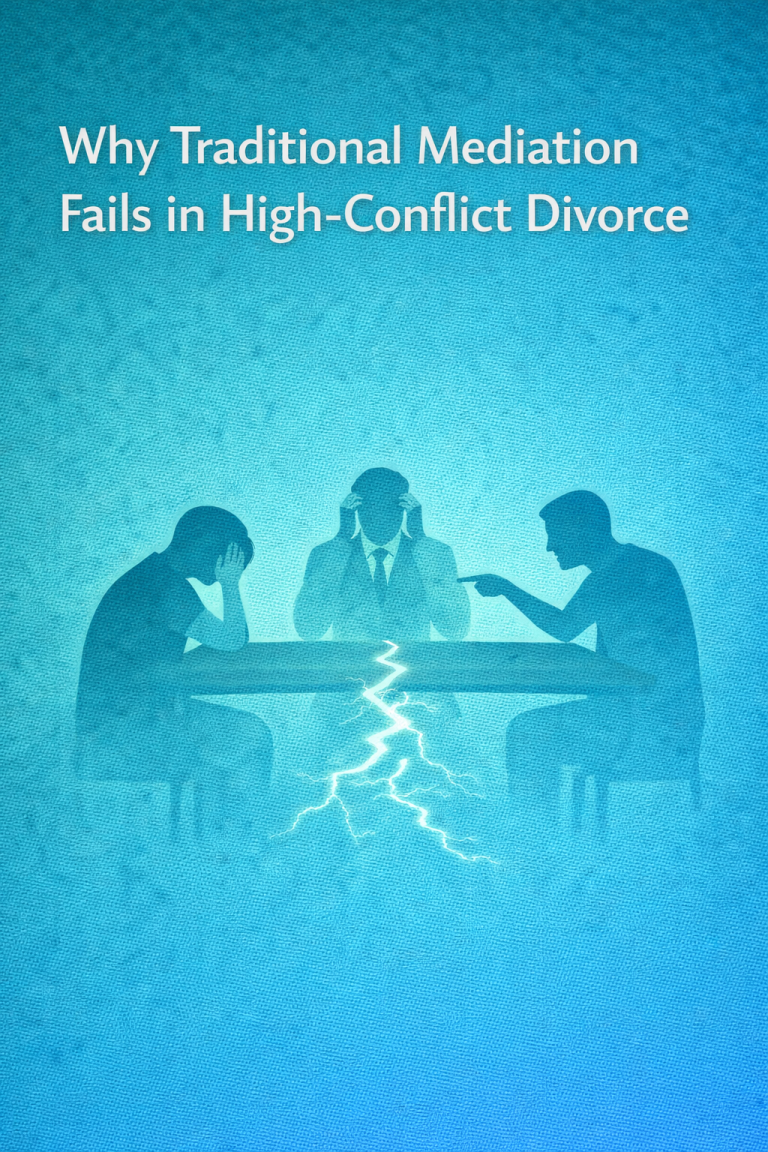
Traditional mediation is often presented as the “healthiest” option during separation. For many families, it can be effective. But for couples navigating high-conflict divorce, especially where emotional manipulation or coercive dynamics exist, traditional mediation frequently fails — and can cause further harm.
This failure is not due to a lack of effort by one or both parties. It is usually due to a process mismatch.
The Core Assumption Behind Traditional Mediation
Traditional mediation assumes that both individuals:
- have relatively equal power
- can self-regulate emotionally
- can negotiate without fear or intimidation
- are motivated by mutual resolution
In high-conflict dynamics, these assumptions often do not hold.
Power Imbalance Changes Everything
When one party dominates through emotional pressure, intimidation, financial control, or persistent blame, the mediation room becomes unsafe.
The less powerful party may:
- agree simply to end the interaction
- shut down or dissociate
- doubt their own perception due to repeated reality distortion or gaslighting in divorce and custody disputes
- feel pressured to “be reasonable”
An agreement reached under pressure is not a durable agreement.
Emotional Dysregulation Escalates Conflict
High-conflict divorce often involves rapid emotional escalation. Without strong facilitation and containment, mediation sessions can become:
- emotionally overwhelming
- retraumatizing
- chaotic or circular
- unproductive
This leads many clients to leave mediation feeling worse than when they started.
Neutrality Without Structure Can Enable Harm
Neutrality is often misunderstood as “non-intervention.”
In high-conflict cases, this can unintentionally allow:
- intimidation to go unchecked
- manipulation to go unaddressed
- emotional harm to continue within the process
Ethical mediation requires more than neutrality — it requires structure and safety.
Why Psychotherapy-Informed Mediation Is Different
A psychotherapy-informed mediation model recognizes:
- trauma responses
- power imbalance
- emotional regulation limits
- post-separation abuse patterns
This allows the mediator to structure the process in a way that protects emotional safety and focuses on sustainable outcomes.
Families seeking a safer alternative may consider family mediation for high-conflict divorce & co-parenting designed specifically for complex relational dynamics.
FAQs
Is mediation ever appropriate in high-conflict divorce?
Yes — when the process is structured specifically for high-conflict dynamics and includes screening and firm facilitation.
What if mediation made things worse before?
That often means the model was not appropriate for the dynamics involved.
