
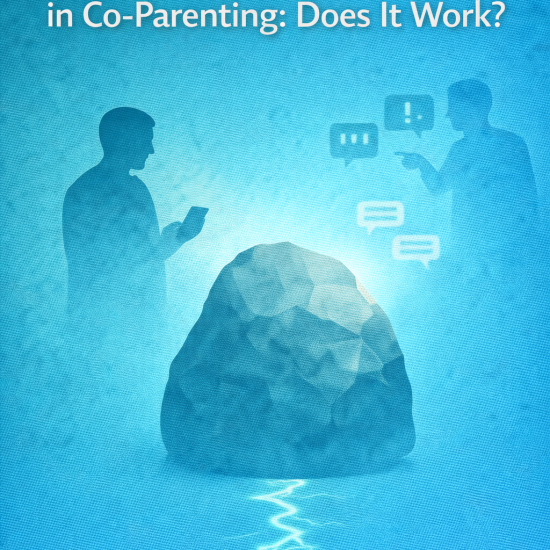
Grey rock communication is often recommended in high-conflict relationships, especially when one parent repeatedly provokes, criticizes, or attempts to destabilize conversations.
The concept is simple: become emotionally neutral, calm, and uninteresting. Respond briefly. Avoid emotional explanations. Do not engage in reactive debate.
For many parents navigating high-conflict divorce, grey rock is the first strategy that reduces escalation.
But grey rock is not a complete solution.
It is a containment tool — not a co-parenting model.
What Grey Rock Actually Means in Co-Parenting
Grey rock communication typically includes:
- Brief, factual responses
- Neutral tone
- No emotional justification
- No defending against every accusation
- No re-engaging once the topic is answered
It is not silence.
It is not passive aggression.
It is not emotional shutdown.
It is structured non-reactivity.
Grey rock works best when the goal is to reduce emotional fuel — not to change the other person’s behavior.
Why Grey Rock Feels So Powerful at First
In high-conflict dynamics, escalation often relies on emotional engagement.
When one parent stops reacting:
- The conflict loop can weaken
- Emotional intensity may decrease
- Conversations become shorter
- Energy is conserved
For some families, this shift alone creates immediate relief.
However, relief does not always equal resolution.
When Grey Rock Works Best
Grey rock is most effective when combined with structural supports, such as:
- Topic restrictions
- Written-only communication
- Defined response windows
- A clear and detailed parenting plan
Without these frameworks, grey rock can quickly collapse under pressure.
For practical communication structure, read:
Communication Boundaries for Co-Parenting Under Stress
When Grey Rock Fails
Grey rock may fail when:
- The other parent escalates intensity to provoke reaction
- Communication frequency is excessive
- Parenting schedules are vague
- There is ongoing intimidation or coercive behavior
- Legal threats are used strategically
In some cases, grey rock unintentionally increases pressure because the underlying power imbalance has not been addressed.
When cooperation is not realistic, a parallel parenting model may provide stronger containment.
Read:
Parallel Parenting vs Co-Parenting in High-Conflict Divorce
Grey Rock vs Parallel Parenting
Grey rock is a communication technique.
Parallel parenting is a structural model.
Grey rock controls tone.
Parallel parenting controls exposure.
If the conflict pattern is persistent, structural change often matters more than tone control.
The Limits of Grey Rock in High-Conflict Divorce
Grey rock can reduce emotional fuel — but it cannot:
- Clarify decision-making authority
- Enforce schedule compliance
- Prevent repeated negotiation attempts
- Stop boundary violations
When communication rules are not formalized, grey rock becomes exhausting.
Containment requires agreement.
In many cases, a psychotherapy-informed mediation process is needed to formalize communication rules and reduce repeated destabilization.
How Mediation Can Support Grey Rock Structure
Grey rock works best when supported by:
- Clearly defined communication protocols
- Specific response timelines
- Escalation pathways
- Parenting plans built to function under stress
Structured mediation can formalize these supports so that emotional containment does not depend solely on individual effort.
Frequently Asked Questions
Is grey rock communication healthy?
Grey rock can be a protective strategy when communication feels emotionally unsafe. It is not a substitute for healthy co-parenting where respect and collaboration are possible.
Should I ignore messages entirely?
Not necessarily. In most cases, structured response windows and topic restrictions are more sustainable than silence.
Can grey rock reduce legal conflict?
Grey rock may reduce escalation in communication. However, sustainable conflict reduction typically requires structured agreements and clearly defined boundaries.
