
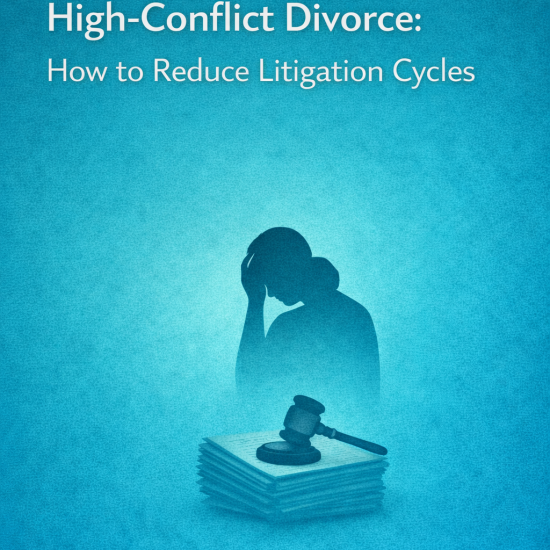
High-conflict divorce can become a cycle of repeated legal conflict. Many parents describe feeling trapped in an exhausting loop of motions, accusations, and constant stress.
This is often referred to as court fatigue high-conflict divorce dynamics—a state of emotional burnout where parents lose clarity, financial stability, and mental energy.
Children often experience this indirectly through chronic tension, unpredictability, and parental exhaustion.
Court fatigue is not just about legal bills.
It is about cumulative psychological strain.
Why Litigation Cycles Repeat
Litigation cycles often repeat because:
- The parenting plan is vague
- Boundaries are not enforceable
- Communication remains chaotic
- Conflict becomes a form of control or pressure
- Issues are revisited endlessly
When agreements lack clarity, conflict fills the gap.
If every disagreement returns to court, the system itself can become part of the conflict pattern.
How Structured Mediation Can Help
Mediation is not always appropriate in high-conflict cases. However, when screening indicates it can be conducted safely, a psychotherapy-informed approach may reduce repeated legal conflict.
Structured mediation focuses on building:
- Clear schedules
- Defined decision-making boundaries
- Communication rules
- Conflict-reduction protocols
- Containment strategies for escalation
When agreements are specific and realistic, fewer issues require legal intervention.
In many cases, family mediation to reduce ongoing conflict can interrupt repeated litigation cycles by formalizing clearer agreements and communication structures.
The Role of Communication Boundaries
Many litigation cycles begin with communication escalation.
An argument over tone can become a legal motion when patterns are entrenched.
Clear communication boundaries reduce:
- Reactive messaging
- Misinterpretation
- Escalation
- Repetitive conflict loops
For practical strategies, read:
Communication Boundaries for Co-Parenting Under Stress
When Parallel Parenting Reduces Conflict
Some families reduce conflict most effectively by reducing contact.
Parallel parenting minimizes direct interaction and narrows communication to essential logistics.
When cooperation is unrealistic, reduced exposure can prevent repeated disputes from escalating into legal action.
Learn more here:
Parallel Parenting vs Co-Parenting in High-Conflict Divorce
Frequently Asked Questions
Can mediation prevent repeated court conflict?
It can help when agreements are structured clearly and communication boundaries are formalized. Outcomes depend on screening, safety, and willingness to participate.
What if conflict keeps returning no matter what?
This may indicate the need for stronger boundaries, clearer agreements, or a different legal or professional pathway. Not all conflict patterns can be resolved through negotiation alone.
Is mediation cheaper than court?
Often yes. However, the priority should be safety and appropriateness—not cost alone. An unsuitable mediation process can increase long-term conflict.
