
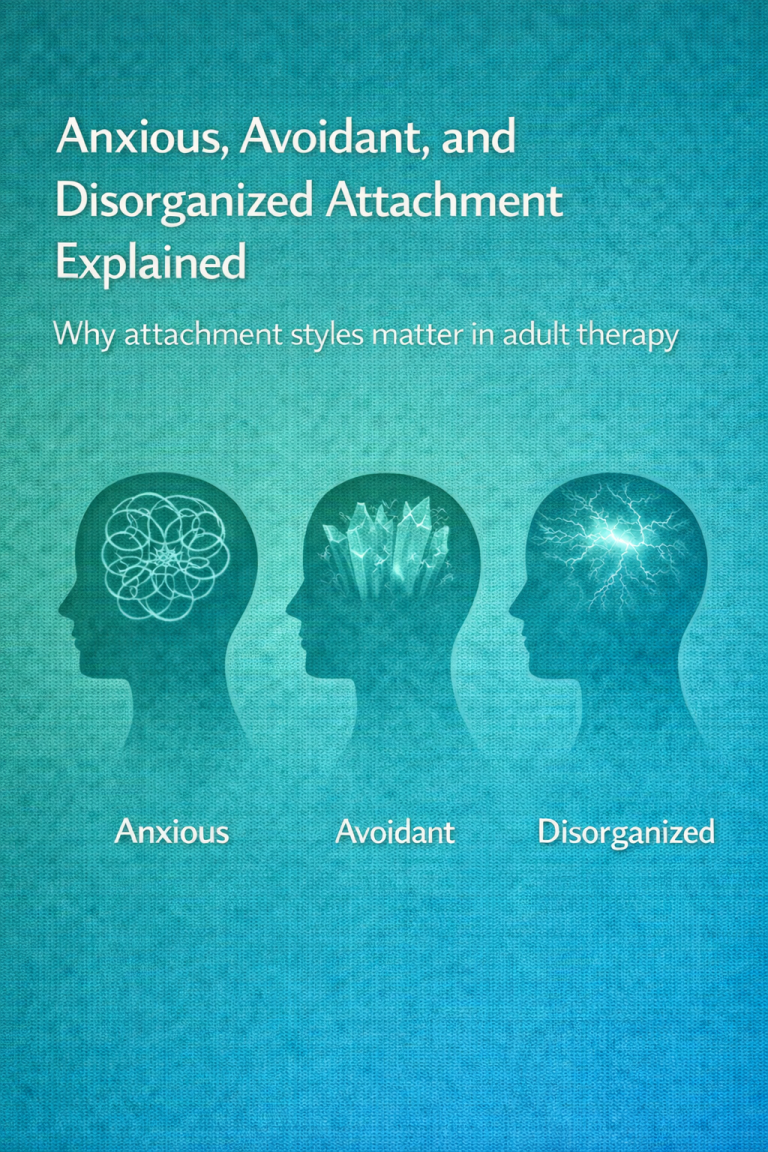
Why attachment styles matter in adult therapy
Many adults blame themselves for relationship struggles without realizing that their reactions are shaped by attachment patterns formed early in life. Attachment styles are not personality flaws — they are adaptive responses to early relational environments.
Understanding attachment styles often brings relief, clarity, and self-compassion.
In therapy, exploring attachment styles helps adults understand relational patterns that developed in response to early caregiving experiences.
What is attachment?
Attachment refers to how we learned to seek safety, connection, and regulation through caregivers. When caregivers were emotionally responsive, children developed secure attachment. When caregivers were inconsistent, dismissive, or controlling, insecure attachment patterns often formed.
Anxious attachment
Adults with anxious attachment may:
- Fear abandonment
- Seek reassurance excessively
- Feel hyperaware of others’ moods
- Struggle with self-worth in relationships
This pattern often develops in environments where love was inconsistent or conditional.
Avoidant attachment
Avoidant attachment often presents as:
- Emotional independence
- Difficulty expressing needs
- Discomfort with closeness
- Withdrawal during conflict
Avoidance is not lack of feeling — it is a protective strategy developed when emotional needs were unmet or dismissed.
Disorganized attachment
Disorganized attachment combines both anxious and avoidant responses. Individuals may crave closeness yet feel unsafe when it occurs.
This pattern is common in:
- Narcissistic family systems
- Emotionally abusive environments
- Homes with unpredictability or fear
Healing attachment patterns in therapy
Attachment-based psychotherapy focuses on helping adults understand how early relational experiences shaped their attachment patterns — and how safety, trust, and connection can be rebuilt over time.
This work often emphasizes:
- Emotional safety
- Relational repair
- Nervous system regulation
- Building secure internal attachment
👉 Learn more about Attachment-Based Psychotherapy for Adults
If you’re not sure how these attachment patterns apply to your experience, you don’t have to label yourself or decide anything yet.
👉 Start here to orient safely and explore support at your own pace
When you’re ready, you can also book a confidential consultation.
