
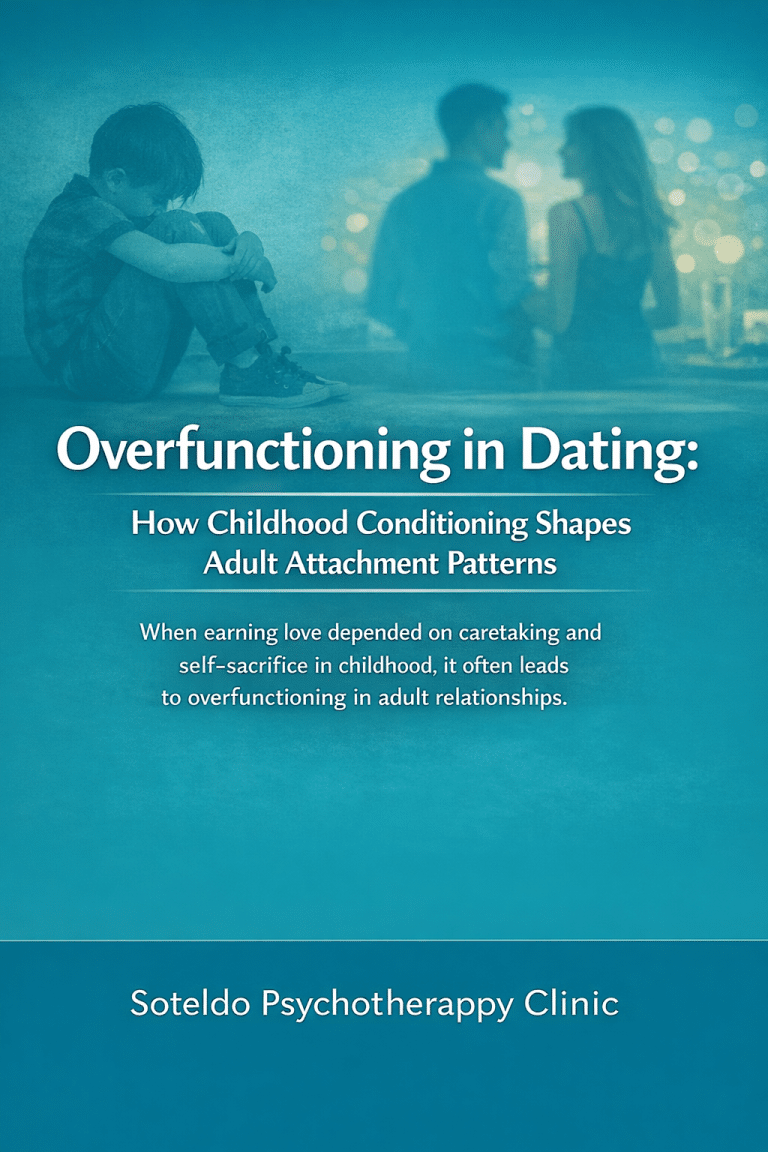
People often praise overfunctioning in dating.
It can resemble emotional intelligence, generosity, or being “good at relationships.” However, many people don’t choose overfunctioning consciously. Instead, they develop it as a survival strategy early in life.
When you rescue, emotionally manage, or work overtime to secure someone’s attention or availability, those behaviors rarely appear by accident. More often, childhood environments shape them—especially environments where love, safety, or connection felt conditional.
When Love Had to Be Earned
Your earliest relationships teach you how connection works.
If caregivers behaved unpredictably, rejected emotional bids, or showed inconsistency, a child often learned to earn closeness. Emotional availability depended on being helpful, mature, compliant, or emotionally quiet.
In these environments, children adapt by becoming hyper-aware of others’ needs while disconnecting from their own. This response doesn’t signal a flaw—it reflects protection in the face of instability.
The child learns a powerful rule: If I do more, I’ll be loved.
How Overfunctioning Shows Up in Adult Dating
In adulthood, these early strategies often resurface in romantic relationships.
You may notice yourself:
- Offering excessive emotional labor
- Trying to fix problems before they become conflicts
- Reassuring your partner at the expense of yourself
- Feeling responsible for keeping the relationship stable
Overfunctioning becomes a way to manage anxiety and prevent abandonment. When emotional distance appears, the nervous system interprets it as a threat—and caretaking becomes the response.
The Role of Parental Rejection
Parental rejection doesn’t always look dramatic.
Sometimes it’s subtle: emotional unavailability, lack of attunement, or inconsistent presence. Over time, children internalize the belief that love must be earned through effort or self-sacrifice.
That belief often carries into dating, where effort becomes confused with worth and responsibility becomes confused with intimacy. The more you give, the safer the connection feels—at least temporarily.
Why Overfunctioning Is So Draining
Overfunctioning keeps the nervous system in a state of vigilance.
Constant emotional monitoring and caretaking activate stress responses, leading to exhaustion, anxiety, and emotional burnout. While overfunctioning may temporarily reduce anxiety by creating a sense of control or usefulness, it ultimately disrupts relational balance.
You end up responsible not only for your own emotional regulation—but for someone else’s as well.
That’s not intimacy.
That’s survival.
Overfunctioning Is an Adaptation, Not a Flaw
It’s important to name this clearly: overfunctioning is not a character defect.
It’s an adaptation that once protected you.
But what helped you survive childhood can quietly undermine mutuality and connection in adult relationships—unless it’s brought into awareness.
Awareness is the turning point.
From Earning Love to Experiencing It
Healing begins when you ask a different question.
Not “How can I make this work?”
But “Why am I trying to save this?”
When you begin to meet your own needs, tolerate emotional uncertainty, and build internal safety, the urge to overfunction softens. Relationships shift from effort-based to reciprocal.
Love no longer has to be earned.
It can be experienced—through presence, equality, and emotional availability.
